Introduction:
A proportion is two ratios that have been set equal to each other; a proportion is an equation that can be solved. When I say that a proportion is two ratios that are equal to each other, I mean this in the sense of two fractions being equal to each other. For instance, 5/10 equals 1/2. Solving a proportion means that you are missing one part of one of the fractions, and you need to solve for that missing value. For instance, suppose you were given the following equation:

You already know, by just looking at this equation and comparing the two fractions, that x must be 5, but suppose you hadn't noticed this. You can solve the equation by multiplying through on both sides by 10 to clear the denominators:
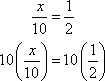
x = 5 Copyright © Elizabeth Stapel 1999-2009 All Rights Reserved
Verifying what we already knew, we get that x = 5.
Often times, students are asked to solve proportions before they've learned how to solve rational equations, which can be a bit of a problem. If you haven't yet learned about rational expressions (that is, polynomial fractions), then you will need to "get by" with "cross-multiplication".
To cross-multiply, you take each denominator ACROSS the "equals" sign and MULTIPLY it on the other fraction's numerator. The cross-multiplication solution of the above exercise looks like this:

Then you would solve the resulting linear equation by dividing through by 2.

No comments:
Post a Comment